Thursday, 19 August 2010

On true art (2)

Here's another excerpt that underlines my point of view very eloquently:

There is nothing intrinsically wrong with enjoyment per se - I like having a good time as much as anyone. However, in order for a work of art to be successful, it needs to pull as well as push - often, the goal is to anger, disturb, or even to deliberately bore or tax the audience, viewer, or listener in pursuit of some larger goal. The obvious response to this is the one we have heard throughout the history of modern art - "it's pretentious bullshit," "my kid could paint that," etc. And yes, that is often the case. However, even work that enlightens or entertains often needs to mystify, or to defer pleasure, in order to be successful. Of course what we say we want is the thrill, the laugh, the cheer, the beautiful sound or object, but most often those moments need to be surrounded by something else, or the experience is meaningless - art as a series of positive stimuli that zaps our animal brains in a pleasing way, but offers little else.
(by Jason Grote)


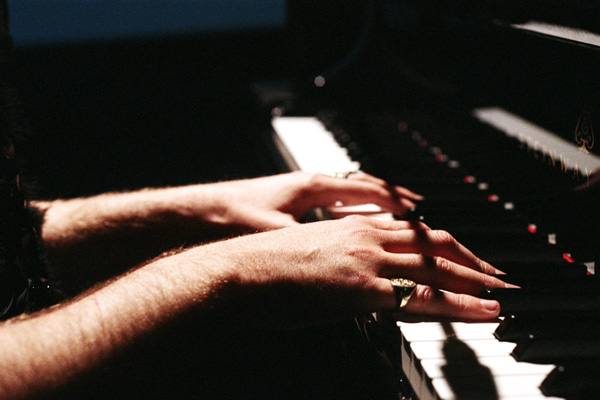
I thought I had suppressed those animal brains but looking at it this way, it seems I've been using them all along. The laugh, the beautiful sound, the shape of hands caressing the keys, God's thumb. Impressions. But then offering endlessly more.

Monday, 16 August 2010

Beauty in simplicity - Sonnet 20


I adore Rufus Wainwright and this Sonnet sums it all up for me. I've seen him playing it while wearing a pompous long black dress with feathers and sequins - a 15 feet long train trailing behind him. But this little video offers as much Rufus as you can get, he's all there and giving everything - every time. He's for real.

Wednesday, 23 June 2010

On true art

“It’s something which reverberates within your psyche, it disturbs the whole life cycle within a person. It affects the atmosphere in which you live. Most of what its called art, your eye just flows over. It may be charming or nice, but it doesn’t change you”. Francis Bacon

Monday, 21 June 2010

June 21st

There you have it, the longest day. It is what it is.
It should be nice & warm but I feel cold.

Saturday, 19 June 2010

Synchronicities

I wrestled with a blog post a few weeks ago and then let it rest a bit. Today I found the incentive to pick it up again. Here's what I wrote before:

Last week was a pretty turbulent one, as in pretty AND turbulent. I attended two concerts in a row in the same city, and the contrasts were quite remarkable. Jónsi in Paradiso (the ‘Pop Temple’, mostly for indie music) vs. Rufus Wainwright in Carré (massive, rather high-brow, think opera and plays). One general admission standing, one seated in plush. Different audiences, age wise and otherwise.

Different also from the opera I attended in London last April. Very, very different from the concert in London that was cancelled (and is still eagerly expected in September), the idiosyncratic Whale Watching Tour. I feel like a chameleon.

I am always very apprehensive of ‘recommendations’ – if you like this, you might like this as well, or – people who bought this, also bought this. It’s even worse when friends do it. I hate to disappoint them because apparently music comes in clusters for them and you just have to choose which one fits you.

Music doesn’t fit me, I fit into music and somehow I fit into lots of different music. I guess the common denominator for me is not genre based. Then what is it based upon? I will try to tackle this issue from different sides.

Firstly, music is not just notes to me. Just like the books I care to read are not just words and the art I like to watch is not just paint on a canvas. I can (and do) find music in my books and words in the paintings I love. The thing I’m looking for is not media specific, if that makes any sense.

Secondly, I don’t care for things that are pleasing to the eye only, or to the ear only. Or things that touch the mind / soul / body only, for that matter. How can anything be perceived as ‘beautiful’ if only one sense, one part of your being is involved? Think about it. It seems such an obvious thing to say but it sums up my life. And it’s not easy if you feel that way, trust me.

Above all, I seek intensity in life. What a strange paradox, somebody hypersensitive craving sensory overloads. But with the above in mind, imagine what it feels like for me when all senses are involved, when my whole being is touched by something or someone. It happens and most of those instances turn out to be intertwined in some way, convincing me it’s not just a personal thing. Francis Bacon talking about his paintings and Ben Frost talking about his music are almost interchangeable. Ben using metaphors from visual art with the same impact. Rufus reaching over the ages by setting Shakespeare’s timeless sonnets to music. Nico Muhly contributing to both Jónsi’s and Rufus’ last albums, touring with the Whale Watching Tour, while being a classical composer. Intertwined on many levels.

I agree, that does make me seem blasé a lot of the time because I perceive many things as superficial that others marvel about. They seem to be able to find joy in fleeting fancies, which is all right of course – just not for me.

And then John Adams, on his highly recommendable blog 'Hell Mouth', writes as follows:
The critic and aesthetic philosopher Walter Pater, who lived at roughly the same time Flaubert flourished (around the middle of the 19th century), talked a lot about the “sensuous material” in a work of art, i.e. the pure sources of stimulus before they’ve been processed in the viewer’s or reader’s or listener’s mind by intellection. This “sensuous material” is for Pater the most important element in a work of art.

The aesthetic experience for him is a kind of three-fold process that begins with the sense organs receiving an impression (a sound, a visual image, a tactile or even olfactory stimulus). Then the intellectual process kicks in, analyzing the stimulus and processing the data, comparing it with previously stored experience. This is the cognitive state. Finally a third, synthesizing activity that Pater calls “imaginative reason” goes into action. “Imagination” in the sense that Pater uses it is a higher, more sophisticated process than either mere perception or “mere” intellectual reasoning, being a sort of fusing of both the sensory experience and its intellectual, analytically derived interpretation.

If this process is successfully carried out a kind of sublime meta-experience takes place, producing a situation in which the “sensuous material” is experienced as pure form. If I understand him correctly, this then would be the essence of the aesthetic encounter.

Lovely. More to follow on similarities in art. Wait for quotes by Francis Bacon and Mark Rothko, coupled with quotes by Ben Frost. Remarkable stuff, I promise!
Monday, 26 April 2010

Happy sad

I still have this "happy/sad" feeling (Tim Buckley always comes to mind) from when I got back from five days in London.

Happy, because we had a swell time, my daughter and I - dividing our attention between shopping, culture and good food. Sad, because the concert I was soooo looking forward to for months on end, had been cancelled. Remember that ash cloud?

While we were there, I got several text messages from my son, informing me about The Whale Watching Tour. With great apprehension, I postponed reading every message until I felt up to it (after a very nice meal for instance).

So it was during these peaceful moments that I learned about the start of the greatly anticipated tour in Berlin being cancelled because more than half of the musicians & crew weren't able to fly in. Next day, Ghent was also cancelled but there was still a positive feeling about London. Until Monday morning.

As I said, I love to combine culture with shopping. I love to have a 'goal' set when planning a trip abroad, something to really look forward to, besides the usual treats a foreign city has to offer. With this 'goal' gone, the rest of the trip was different. I felt sad.

On top of that, I felt jealous once I got home and discovered that the tour had finally taken off. I wonder if I will be able to get front row tickets for the rescheduled concert in September... apart from the hassle of getting days off from work again - and the money involved.

I really, really needed that break - and now I feel more exhausted than before.
The things we do for the music we love.

Friday, 9 April 2010

Facebook & the library

(...)it has become clear that Google is recovery, just like the great library it was built to be. You don’t walk in a library and get handed books by librarian. You go to a section and find what you are looking for.

A comment on a great blog post that stuck in my mind. The social web is all about discovery, not recovery. The media were all over the 'battle' between Facebook and Google when for the first time ever, Facebook had more hits than Google. But the distinction that is so well put in those few words above, shows that these giants are not up against each other as they represent different things. You go to the (Google) library, define your search word (section) and find what you are looking for.

Now go to your Facebook homepage (assuming you have a friend list that mirrors your everyday life/work/interests) and discover. During the time you were away, friends have handed you all kinds of information: links to websites, videos, pictures. But they've also handed you emotions and experiences, whether you asked for them or not.

And there's more! They've let you know they liked the video you put up earlier and have given you an update on a link you posted. This makes you feel good. Makes you feel like a librarian just handed you a book, knowing you'd be interested. It's all about caring.

Libraries have been struggling long and hard to resist Google but most of them have incorporated it into their everyday work now. It's all about recovery, right? Question is whether we want the 'caring' part of information distribution too.

For me, Facebook has become an aggregation device of sorts. I know it makes me neglect my Netvibes pages just because it is more personal, more interactive, more real time. It serves as a big inhale of what's going on right now among the people and issues I care for. I think the best thing it has taught me is that most of the time information doesn't have to be exhaustive to be satisfying. When it does, I will still have Google (the library).

Now read that great blog post: How Internet Content Distribution & Discovery Are Changing